Performance-portable multigrid solvers for semi- and block-structured grids in computational solid mechanics
Funding Agency
Deutsche Forschungsgemeinschaft (DFG)
Funding Period
2026 – 2029
Project Abstract
Multigrid methods are well established in computational solid mechanics and offer performance and scalability for many applications. This project sets out to devise specialized solvers, efficient algorithms, and performant software implementations to deliver the full potential of modern computing technology for applications in computational solid mechanics through the development of scalable and performance-portable algebraic multigrid preconditioners with a particular focus on leveraging grid structure in semi- or block-structured grids, as they can arise in complex FEM meshes or multi-patch IGA meshes with their inherent tensor-product characteristics. The multigrid framework is provided by the package MueLu, which is embedded in the open source library Trilinos in order to realize distributed parallel computations on state-of-the-art hardware.
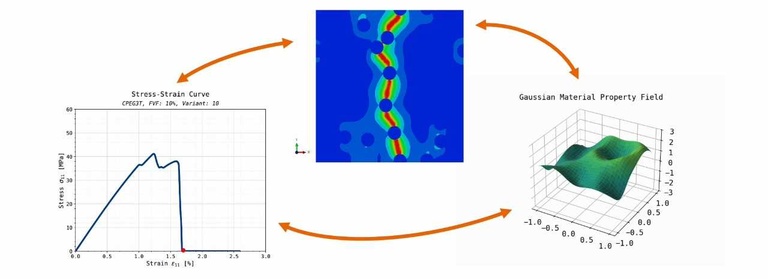
The InterPlaS project investigates how various damage mechanisms in fiber-reinforced composites - such as plasticity, crack formation, and delamination - influence each other and shape the material behavior up to fracture. To this end, numerical models are being developed on the micro and macro scales that capture both the physical processes in the fibers and the matrix and describe their interaction in the laminate. A particular focus is on predicting delamination under complex loading conditions and quantifying unavoidable uncertainties resulting from material variations or manufacturing tolerances. Modern probabilistic methods are used for this purpose, allowing a more realistic assessment of model quality. The aim of the project is to create a deep understanding of multiscale material behavior and, at the same time, to provide computational methods that enable reliable statements to be made about the safety and service life of components made of fiber-reinforced composites.
In the numerical simulation of complex physical processes, large linear systems of equations often arise, where multigrid methods play a key role as efficient preconditioners for the iterative linear solver. Selecting appropriate solver parameters is crucial for solver performance, yet poses a major challenge due to the required expert knowledge in multigrid methods.
To this end, this project probes the application of global sensitivity analysis (GSA) methods to iterative linear solvers. The aim is to identify the most influential and performance-critical parameters as well as those with minor impact on solver performance in order to guide application engineers in their efforts for solver parametrization.
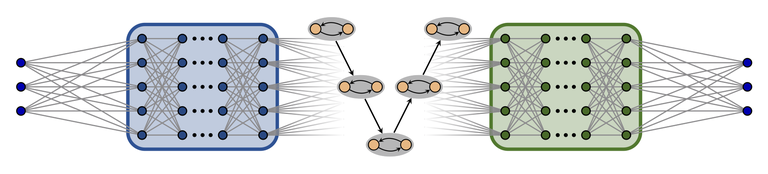
Because direct sensitivity analyses based on computationally demanding simulations (such as fluid-structure interaction or beam-solid problems) are computationally expensive, the training and use surrogate models are explored. These models enable an efficient estimation of parameter sensitivities at greatly reduced computational cost.
Ideally, the results provide deeper insight into parameter effects and lay the foundation for the automatic optimization of solver parameters using machine learning methods, thereby improving the robustness and efficiency of modern numerical solvers.
Contact is central to many engineering applications and governs force transfer, separation, sliding and friction between interacting bodies. Its nonlinear nature makes accurate simulations computationally demanding, especially for complex three-dimensional models and large deformations.
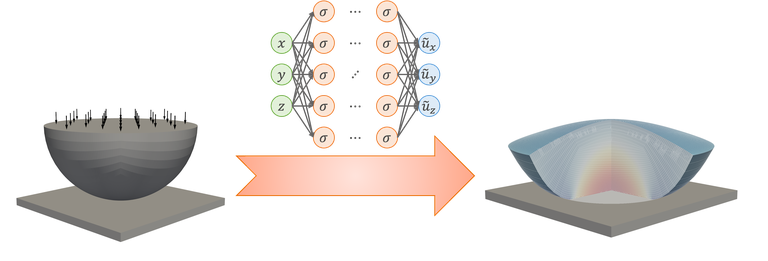
The PICO project investigates physics-informed machine-learning methods for contact mechanics. Starting from physics-informed neural networks (PINNs), the project plans to investigate energy-based PINNs (EPINNs) and variational formulations that provide closer links to established finite-element methods. The developed approaches will be studied for two- and three-dimensional contact problems, including small and large deformations as well as frictionless and frictional contact.
A central goal is to combine the flexibility of machine learning with the accuracy and reliability of classical numerical methods. Trained physics-informed models will therefore be investigated not only as standalone solvers, but also as components of hybrid solution strategies that combine them with classical finite-element-based solvers.
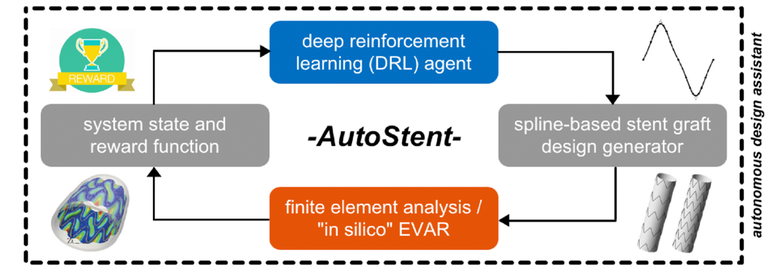
The AutoStent research project focuses on developing an autonomous design assistant for customized stent grafts used in endovascular aneurysm repair (EVAR). The project combines deep reinforcement learning with spline-based geometry generation and finite element simulation to explore and evaluate patient-specific stent graft designs. Unlike conventional approaches that rely on off-the-shelf grafts and expert intuition, AutoStent aims to formalize the design process through algorithmic support, improving the adaptability of stent grafts to individual anatomical conditions. The resulting methods and software are designed to be broadly applicable, with open-source tools supporting further research in computational design and biomechanics.
Stable discretization methods and scalable solvers for embedded fiber/solid coupling
Funding Agency
Deutsche Forschungsgemeinschaft (DFG)
Funding Period
2024 – 2027
Project Abstract
This project targets the development of robust and stable discretization techniques and efficient iterative solvers for mixed-dimensional finite element models of fiber-enhanced continua. Mixed-dimensional finite element models of fiber/solid systems will resolve one-dimensional (1D) fibers with beam models embedded into a three-dimensional (3D) homogeneous solid to deliver a high modeling accuracy and will be innovated by enforcing the coupling constraints via a Lagrange multiplier field to overcome the ill-conditioning of previously used penalty methods. A deep understanding of the interplay between solution algorithms and numerical models will deliver fast and efficient solvers ready for next-generation computing architectures. For the first time, this will employ inf-sup stable Lagrange multiplier spaces in mixed-dimensional fiber/solid models and enable the computational analysis of entire fiber-enhanced components and large systems on supercomputers without suffering from ill-conditioning and the lack of diagonal dominance due to penalty methods.
This project investigates metamaterial properties of locally periodic structures constituted by conventional and smart materials. Smart materials distinguish themselves from standard passive metamaterials by controllability through electroactive components and time-space alternating geometrical layouts.
Controllable and adaptive structures equipped with embedded actuators and sensors connected to electric circuits provide a higher level of multi-functionality such as the capability of vibration and wave propagation control, shape morphing, or modifying stiffness in space and time.
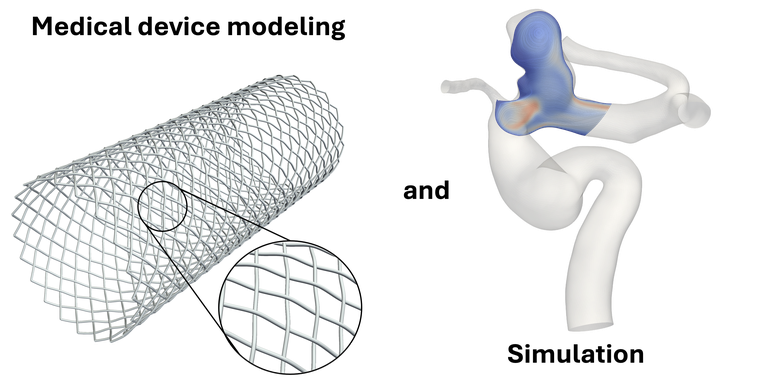
Within this project embedded into the DFG Priority Program 2311, a continuum mechanics approach is being developed for the simulation of the endovascular intervention in cerebral aneurysms with devices such as coils, Woven EndoBridges (Web) or flow diverters. It targets the patient-specific improvement of cerebral aneurysm treatment through predictive simulation and optimization.
IMCS is actively involved in the numerical modeling of the different devices and the involved biochemical processes of blood coagulation in the aneurysm cavity. In collaboration with the project partners, the device and coagulation models will be coupled to a Lattice-Boltzman-based arterial model of the blood flow to predict the long-term treatment outcome and quantify treatment success.
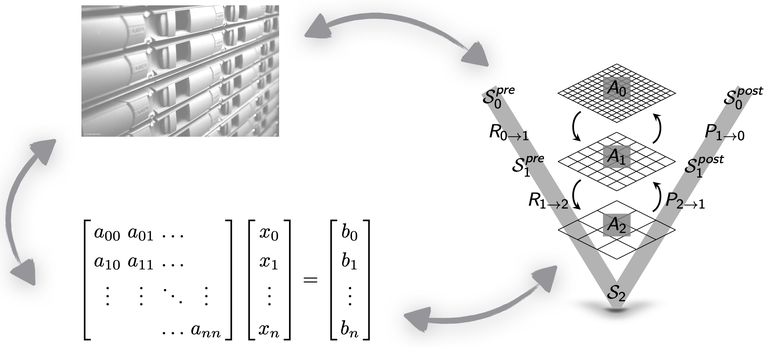
Efficient numerical algorithms play a crucial role in modern simulation software when solving problems in biomechanics, mechanical and civil engineering. In particular, the solution of systems of linear equation in the context of multiphysics problems represents a challenge in which scalable preconditioners play a critical part. Within the research project, approaches for handling the problem-specific block structure of the underlying matrix as well as novel algebraic multigrid approaches are developed. This includes the development of block and single field smoothers, as well as new methods for coarse grid correction. The multigrid framework MueLu and the block preconditioners based on Teko serve as the software environment. Both software packages are embedded in the open source library Trilinos in order to realize distributed parallel computations on state-of-the-art hardware. On the one hand, the developed methods are used in the parallel simulation of beam-solid problems and heterogeneous materials, as occurring in the interaction of concrete and reinforcing steel. On the other hand, the new methods are utilized for the calculation of fluid-solid interactions from biomechanics.
Use of eigenfrequencies for the identification of cracks
Funding Period
2021 – now
Project Abstract
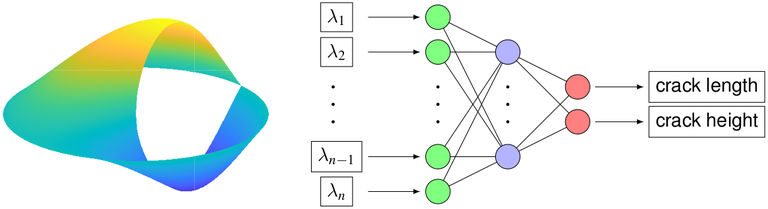
The project focuses on the approximate calculation of eigenvalues of various differential operators on areas with cracks using isogeometric analysis. Methods are to be developed that allow the simulated eigenvalues to represent as accurately as possible the eigenfrequencies of test objects with cracks that can be measured in practice, and also to show corresponding convergence results. Subsequently, these natural frequencies shall be used to identify the crack, i.e., to determine the shape of the crack. This inverse problem is to be solved with a neural network, for the training of which we need simulation data of as high quality as possible in order to be able to guarantee a meaningful application in practice.
Combination of data- and physics-based methods for hybrid digital twins
Funding Agency
Zentrum für Digitalisierungs- und Technologieforschung der Bundeswehr (dtec.bw)
Funding Period
2021 – 2026
Partners
Institutes of dtec.bw project RISK.twin within research center RISK
Project Abstract
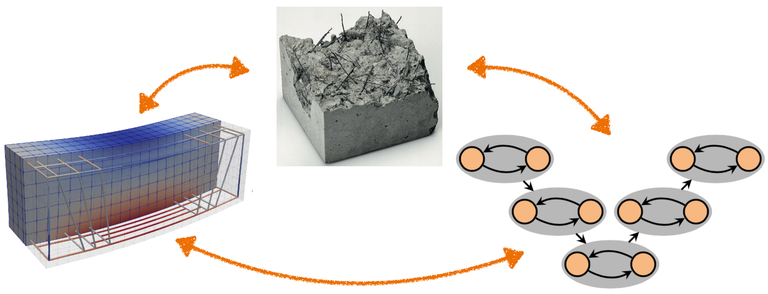
In this project, methods for hybrid digital twins of critical infrastructure are investigated and developed. The main focus is the combination of physics-based modeling using Finite Element Methods (FEM) and data-based modeling with machine learning techniques.
The first application case are steel-reinforced concrete bridges. On the physics-based modeling side, a mixed-dimensional FEM model for steel-reinforced concrete components is developed. Complementary, variants of neural networks are investigated. Both are combined to improve the material model with measurement data and obtain a reduced order model of the physical system.
Still, attention is paid to generality and application independence of the methods, so that the developed techniques can also be used by the project partners. New algorithms are implemented in the form of an in-house software solution. An associated hardware platform for high performance computing is provided at the Data Science & Computing Lab.