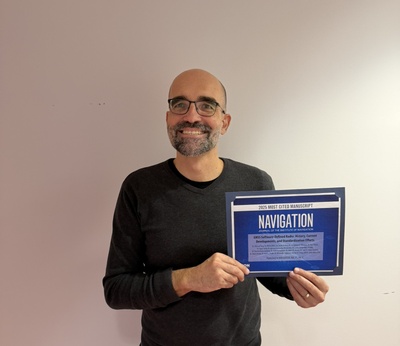
ION-GNSS+ 2025 Baltimore
24 September 2025
The ION-GNSS+ is the most important scientific conference for satellite navigation and took place this year in Baltimore. 30 years of Galileo have been celebrated, and the future of navigation has been discussed.
The institute participated very successfully and contributed to the following presentations:
|
A1 |
Optimizing Performance of Space-Based Detection and Localization of Terrestrial GNSS RFI Based on the Direct Geolocation Algorithm using Vitis HLS: Hepzibah Ernest and Thomas Pany, Universität der Bundeswehr München |
|
D4 |
Testing Integrated GNSS Plus Pseudolite Positioning with a Programmable GNSS-RF-Simulator: Mathias Phillip Blum, Muhammad S. Hameed, Thomas Pany, University of the German Federal Armed Forces |
|
A1 |
An Analysis of Authentication Availability and Enhancements through Vector Tracking for Galileo OSNMA Data and SAS Spreading Code Authentication: Toms Dorins, Thomas Pany, Dominik Dötterböck, Mohamed Bochkati, Institute of Space Technology and Space Applications, Universität der Bundeswehr München; Stefan Baumann, Nikolas Dütsch, Industrieanlagen-betriebsgesellschaft MBH; Andreas Wenz, and Roman Ehrler, SBB Swiss Federal Railways |
|
E3a |
Experimental Framework for Hybrid Navigation Terminals Exploiting LEO PNT Constellations: Francis Soualle, Jose A. del Peral-Rosado, Gabriele Ligorio, Airbus Defence and Space GmbH; Florian Binder, Christian Lichtenberger, Thomas Pany, University of the Federal Armed Forces; Jon Winkel, Receiver Technology; Luca Canzian, Federica Rozzi, Marco Rotoloni, Stefano Garlaschi, Giacomo Castellan, Qascom; Ottavio Picchi, External Consultant for EC; Francesco Menzione, European Commission JRC; Juan Pablo Boyero, European Commission |
|
F6 |
Using a Block Processing Discriminator for Precise Tracking of Starlink Signals in a SBASOLEO User Terminal: Christian A. Lichtenberger, Florian Binder, University of the Bundeswehr Munich; Ottavio Picchi, External Consultant for European Commission Joint Research Center; Francesco Menzione, European Commission Joint Research Center; Thomas Pany, University of the Bundeswehr Munich |
|
D4 |
GOOSE-VTL: GNSS/INS Deep Coupling with Fault Detection Strategy: Szu-Jung Wu, Katrin Dietmayer, Himanshu Gupta, Natalia Conde, Fraunhofer Institute for Integrated Circuits IIS; Mohamed Bochkati, University of the Bundeswehr Munich; Daniel Seybold, TeleOrbit GmbH; Thomas Pany, University of the Bundeswehr Munich; Matthias Overbeck, Fraunhofer Institute for Integrated Circuits IIS; Jürgen Seybold, TeleOrbit GmbH |
|
F2 |
Analysis of a Decentralized Filter Design for a Multi-Receiver Vector Tracking Architecture Under Challenging Conditions: Stefan Laller, University of Technology - Institute of Geodesy; Mohamed Bochkati, University of the Bundeswehr Munich - LRT Satellite Navigation); Philipp Berglez, University of Technology - Institute of Geodesy; Thomas Pany, University of the Bundeswehr Munich - LRT Satellite Navigation |
|
E3a |
Assessment of Potential System Interference through Radio Frequency Compatibility Analysis by Emerging LEO Constellations using L5 Frequency: Himanshu Sharma, Dominik Doetterboeck, Thomas Pany, Universität der BundesWehr Munich |
|
E5 |
Analysis of a Bayesian Optimized Multi-GNSS Synthetic Aperture Processing Under Challenging Signal Conditions: Mohamed, Bochkati, Jürgen Dampf, and Thomas Pany, University of the Bundeswehr Munich (UniBw M) |
|
E3a |
Experimental Framework for Hybrid Navigation Terminals Exploiting LEO PNT Constellations: Francis Soualle, Jose A. del Peral-Rosado, Gabriele Ligorio, Airbus Defence and Space GmbH; Florian Binder, Christian Lichtenberger, Thomas Pany, University of the Federal Armed Forces; Jon Winkel, Receiver Technology; Luca Canzian, Federica Rozzi, Marco Rotoloni, Stefano Garlaschi, Giacomo Castellan, Qascom; Ottavio Picchi, External Consultant for EC; Francesco Menzione, European Commission JRC; Juan Pablo Boyero, European Commission |
|
F5 |
Towards Exploitation of Starlink Signals with Carrier Phase Measurements for Precise Positioning and Geodesy |