Rethinking Airspace Boundaries: Operationalizing Flow-Centric ATM
14 April 2026
Operationalizing flow-centric air traffic management with granular cells and dynamic handover times
S Göppel, M Schultz. Transportation Research Part C: Emerging Technologies 187, 105649
Dynamic, demand-focused airspace management must reduce sector-specific traffic complexity to support air traffic controller operations. The flow-centric concept contributes through the homogenization of aircraft trajectories, and we extend it by grouping aircraft as elements of a granular flow and introducing dynamic handover times between adjacent sectors. The idea of granular flow reflects the view of aircraft as locally dense particles within a collective stream, where interactions are not purely individual but are shaped by density, coupling strength, and available capacity. This perspective captures phenomena such as local congestion in sectors, delay waves, and the propagation of capacity bottlenecks.
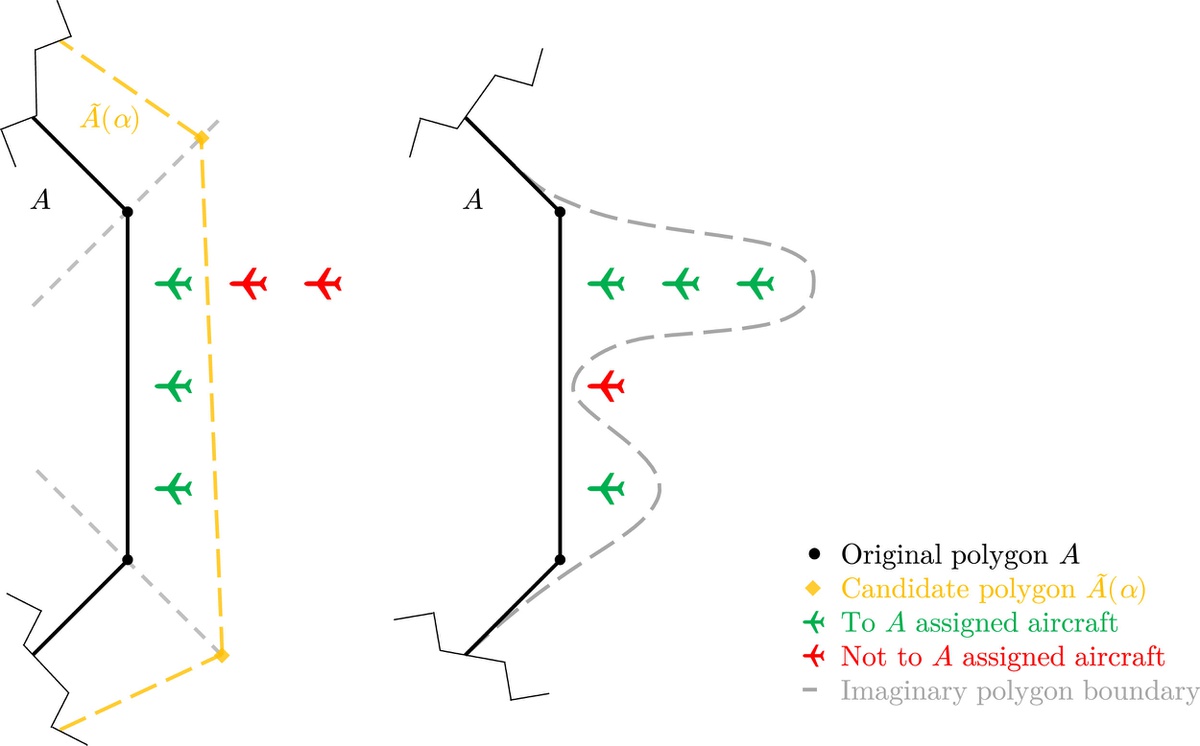
We create granular cells that group flights with similar characteristics. Within each cell, aircraft follow comparable patterns and therefore receive similar instructions from controllers, thereby reducing their taskload. As in granular flow, cells may differ in size, and controllers manage several cells, down to those containing only a single aircraft. Dynamic handover times, derived from airspace boundary parameterization and the direct optimization of handover locations, enable workload-based early or late transfers between adjacent sectors while preserving the legally defined responsibilities of controllers. To assess the impact of modeling air traffic as granular flows, an operational concept is developed and applied to en-route traffic within Singapore’s upper airspace at peak times. Traffic complexity is assessed using 25 parameters encompassing aircraft-, conflict-, and airspace-related aspects.
Granular cells substantially reduce intra-sector complexity, with reductions averaging 17% and reaching up to 50%, while also propagating moderate benefits to adjacent sectors. Dynamic handover times decrease inter-sector complexity by 2% on average, with maximum reductions of 6%. When combined with granular cells, both concepts consistently reduce complexity across all evaluated cases, with an average reduction of 3% and a maximum reduction of 7%. Although the effects of both concepts are not strictly additive, they can overlap.


