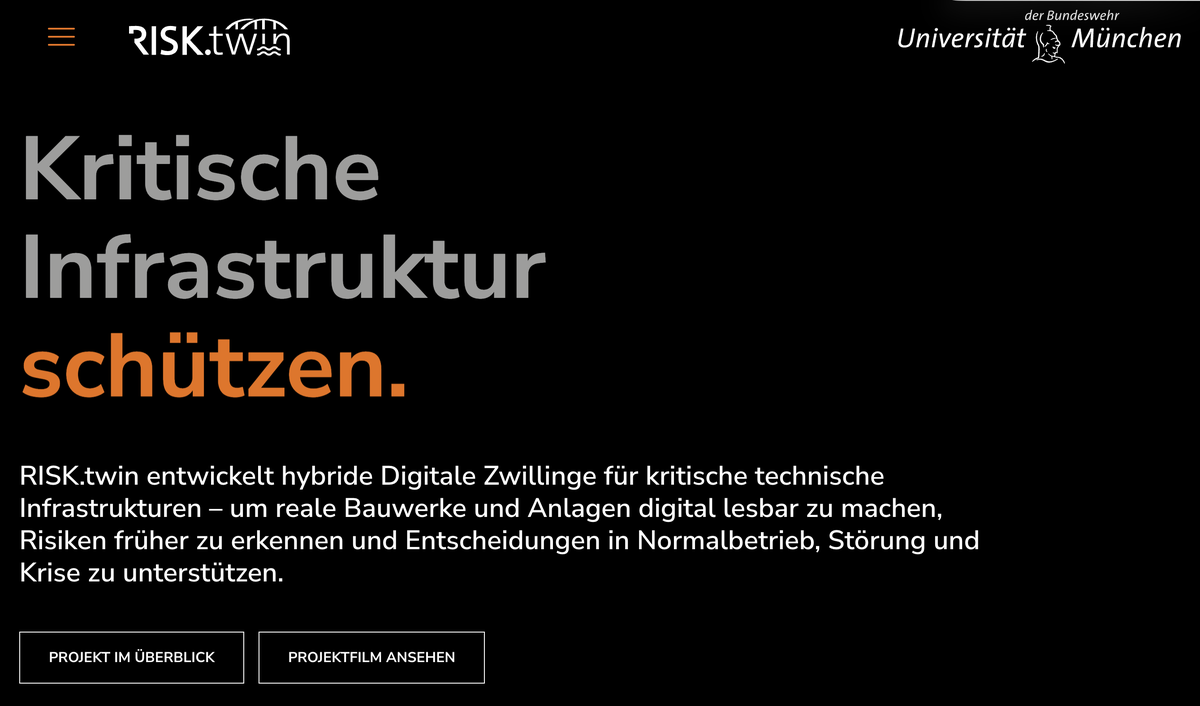
New RISK.twin Website Showcases Six Years of Research
26 Oktober 2026
After six years of research into digital twins and resilient critical infrastructure, the dtec.bw project RISK.twin, led by Prof. Alexander Popp, is approaching its conclusion. The project’s new website, risk-twin.de, provides a permanent digital platform for the work of its interdisciplinary research team. It brings together key results from across the project, explains methods and applications in an accessible way, and offers insights into the experimental facilities and research activities developed over the past six years.
The new website was officially launched on September 14, 2026, at the RISK.twin closing workshop “Resilient Critical Infrastructure: Research, Practice and Digital Twins” in Ottobrunn. Organized jointly with the DLR Institute for the Protection of Terrestrial Infrastructures, the workshop provided an opportunity to reflect on the findings and challenges of the past years while also discussing future perspectives for research on the protection of critical infrastructure. Alongside a keynote by Dr.-Ing. Tobias Koch from the DLR Institute for the Protection of Terrestrial Infrastructures, the program focused on key results from RISK.twin and short highlight presentations by the individual subprojects. The event concluded with a poster session offering further opportunities for discussion and networking.
The website was also presented to RISK.twin’s research and partner network at the third dtec.bw Jahrestagung (article available in German only), held immediately afterwards. Its launch also marks the beginning of a new phase for RISK.twin: dtec.bw funding and the research project in its current form will come to an end on December 31, 2026. The research, experimental facilities, and collaborations established over the past six years, however, will continue beyond the project itself.
This is where risk-twin.de plays an important role. Developed in collaboration with the web agency Isarnauten, it is more than a conventional project website. Serving as both a digital final report and a science communication platform, the website provides a lasting record of RISK.twin’s work while making key topics accessible to audiences beyond the individual research disciplines. A promotional film produced specifically for the new website further supports this aim:
At the heart of RISK.twin is the question of how digital twins can help us better understand critical infrastructure and make it more resilient. The website covers everything from the fundamentals of digital twins and methods such as sensor technology, simulation, machine learning, and virtual reality to specific applications in bridge engineering, building construction, and water and energy infrastructure. In its research, RISK.twin combines physical experimental facilities and real-world sensor data with digital models and novel methods for simulation and data analysis.
Beyond the scientific topics themselves, the website also highlights what will remain after the project ends: research infrastructure and living labs, an established network spanning research and practice, and the wide range of results produced by the researchers involved. Publications and additional resources allow visitors to explore individual topics in greater depth.
Through risk-twin.de, RISK.twin aims to provide a central resource for the project’s research even after its formal conclusion, ensuring that the insights gained from six years of interdisciplinary research remain accessible for years to come.
Visit the new webpage at risk-twin.de.