Titel Selective and Fast Cortisol Sensing in Human Saliva Using Graphene-Based On-Chip Field-Effect Transistors
17 November 2026
Autoren
Bajramshahe Shkodra, Ksenija Arslanova, Eva Fellinger, Tanja Stimpel-Lindner, Sebastian Klenk, Sebastian Hauk, Kathrin C. Knirsch, Andreas Hirsch, Kristiina Iljin, Tarja K. Nevanen, Annette Schmidt, Georg S. Duesberg
DOI
https://doi.org/10.1002/smsc.70405Digital Object Identifier (DOI)
Abstract
|
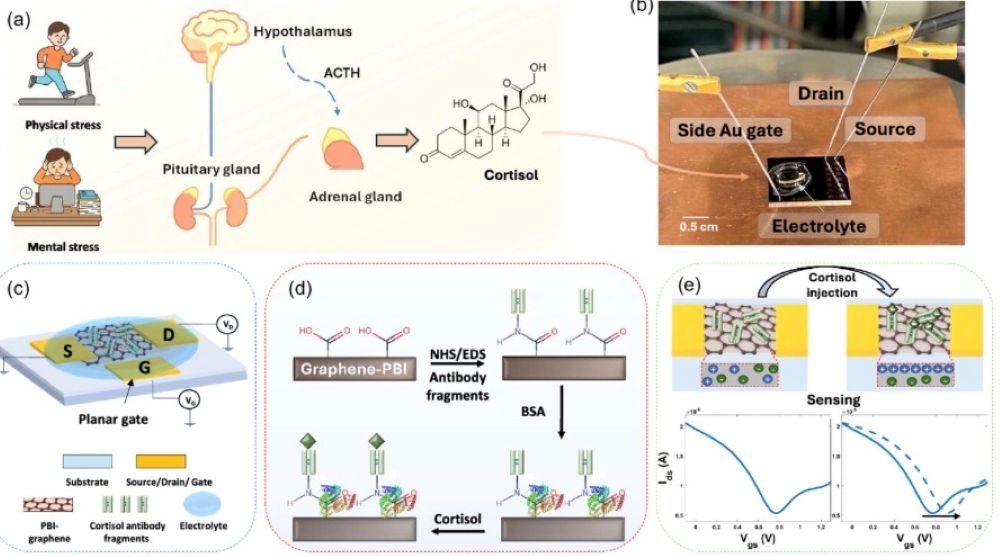
Monitoring of biomarkers in body fluids is highly sought after for medical diagnostics and tracking health conditions. Conventional analytical methods require centralized facilities and complex protocols, limiting applicability for real-time or point-of-care use. In recent years, graphene-based transducers have shown high potential for miniaturized biosensing, however they have so far been hardly tested in real-case scenarios. In this work, electrolyte-gated graphene field-effect transistors (EG-GFETs) are developed for the detection of the primary stress hormone cortisol in human saliva. The sensor consists of chemical vapor deposition (CVD)-grown graphene functionalized with perylene bisimide (PBI) linkers for immobilizing anticortisol (17) Fab fragments. Cortisol is detected over a dynamic range from 100 fM to 1 μM, covering physiologically relevant concentration ranges. The measurements show high correlation with enzyme-linked immunosorbent assay (ELISA) tests performed in parallel on the same samples. The immediate, label-free sensing of biomarkers in human saliva represents a major advance in miniaturized biosensing and can potentially be extended to further analytes and integrated portable monitoring units. |


