Dual Use Goes Operational: How NATO DIANA Brings Cyber Innovation into the Field
17 November 2026
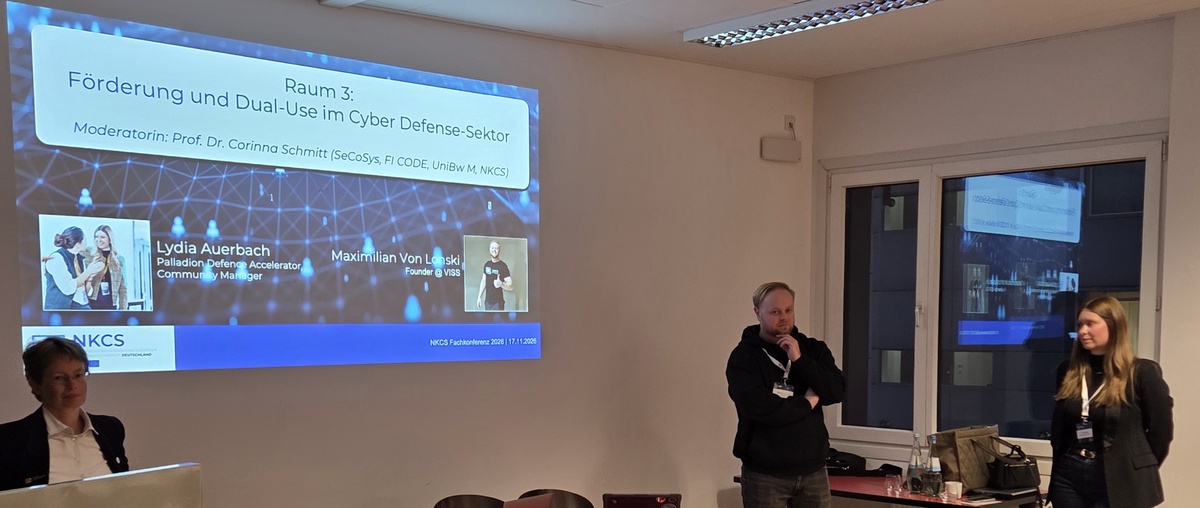
Under the motto “Cybersecurity as a Market of the Future – A European Market for European Products”, the German National Coordination Centre for Cybersecurity (NKCS) invited participants to its annual conference at KOMED in Cologne on 17 November 2026. Room 3 explored how funding and dual use come together in the cyber defence sector, and how a good idea becomes a product that holds up in both the hospital and the command post.
Digital sovereignty is increasingly being thought of in European terms, and the geopolitical situation is accelerating this shift. This year's NKCS conference therefore focused on synergies, cooperation and transfer. As part of the session "(EU) Funding for Research and Development", the breakout "Funding and Dual Use in the Cyber Defence Sector", moderated by Prof. Dr. Corinna Schmitt, offered two perspectives on the same topic: that of the programme bringing innovation into the Alliance, and that of a start-up that has just completed this journey itself.
Lydia Auerbach of the Palladion Defence Accelerator at the University of the Bundeswehr Munich introduced NATO DIANA (Defence Innovation Accelerator for the North Atlantic). Palladion is one of the DIANA Accelerator Sites. It gives innovators resources, networks and mentoring so that new technologies can solve concrete challenges for the Bundeswehr and the Alliance, from operating in denied environments to strengthening societal resilience. The approach follows three steps: (1) Challenge: DIANA identifies priority defence and security needs and competitively selects promising companies. (2) Accelerate: the selected teams receive targeted funding, mentoring, access to test centres and technical support. (3) Adopt: validated solutions move through streamlined pathways into R&D, prototyping and procurement across the Alliance. Examples from current cohorts showed that the model works. Norway’s Fieldmade produces spare parts directly in the field, cutting lead times from months to days. The German start-up Aereus delivers multi-sensor intelligence at the edge. Spain’s Alias Robotics is developing a sovereign, auditable AI workbench for cyber operations in air-gapped networks. For 2027, NATO DIANA has announced six challenge areas: human survivability, autonomy of uncrewed systems, multi-domain sensing and data processing, operational resilience in contested environments, responsive logistics, and scalable countermeasures for air defence. Alongside the Mission Track 2026, the Momentum Challenge 2027 launches in December. Palladion is also looking for military and technical experts to serve as mentors or evaluators. Dates for your diary: the Palladion x DIANA kick-off on 21 January 2027, the Defence & Security Days in March, and Demo Day on 3 June 2027.
Maximilian von Lonski, founder and CEO of VISS GmbH, described what this journey feels like from the perspective of a small company. It all started with a tip: at the CODE Annual Conference in summer 2025, Isabel Grube (Palladion) and Prof. Dr. Corinna Schmitt (RI CODE) advised the team to take a look at NATO DIANA. No sooner said than done: the application, an interview panel at the end of September, acceptance at the end of November, and the kick-off in January 2026. About six months passed between the tip and the start of the programme. VISS solves a problem shared by the civilian sector and the armed forces alike: opening external data without putting your own network at risk. The civilian side is funded through the BMFTR’s StartUpSecure programme, the military side through NATO DIANA. “Two funding routes, one technology: each strengthens the other,” said von Lonski. The six-month programme opened doors that usually stay closed to a young company for a long time. These included a first meeting with NATO Joint Force Command (JFC) Brunssum at the Munich Security Conference, a live demo for JFC Brunssum in Eindhoven, and the DIANA Demo Days. In June, at Eurosatory, VISS received an Expression of Intent from NATO HQ JFC Brunssum. Von Lonski also spoke openly about what no pitch deck covers: security clearance and classified information protection, vetting when hiring, pricing law for public contracts, procurement channels, NATO’s structure, the differences between armed forces, export control and certification. NATO’s structure is a particular challenge for start-ups: the commands define requirements and test solutions in exercises, but purchasing usually happens elsewhere, often at national level, which in Germany means through BAAINBw. Once the programme ended in June 2026, the real work began. In October 2026, VISS presented its solution together with C2Grid and enclaive at the NATO exercise Steadfast Duel, getting direct feedback from operational users instead of relying on assumptions. This has now led to an independent, NATO-funded test campaign in three countries: an architecture review at the Research Institute CODE at SeCoSys, penetration testing at CR14 in Tallinn, and hardware and side-channel testing at ITSec Area in Hungary. In parallel, the CDL Defence programme takes VISS to the Munich Security Conference and to Toronto. The goal for 2027 is to move closer to procurement, in Germany as well.
The session made clear that dual use is no longer just a buzzword but a viable path, especially for small, agile companies. Three key messages stood out:
Engage end users early! An exercise convinces more than any slide. Programmes like NATO DIANA provide exactly this access to commands, test centres and users.
Think civilian and military together! Civilian and military funding are not mutually exclusive; they reinforce each other. A hospital pilot provides evidence that also convinces the military, and vice versa.
Keep at it! NATO DIANA opens the door, but you have to walk through it yourself. Considering the framework conditions early, from classified information protection to procurement, considerably shortens the path to the first contract.
VISS’s story also shows how much a network can achieve: a tip at a conference led, within little more than a year, to a NATO exercise and a NATO-funded test campaign. Anyone ready to take the step themselves will find a first point of contact at the Palladion Defence Accelerator (innovator@unibw.de), and the NATO DIANA Challenges 2027 are already underway. As a partner of the NKCS, RI CODE serves as a bridge to European funding programmes (Horizon Europe and Digital Europe). It can connect innovators to a wider network, opens doors to many different communities, and shares first-hand insights into what happens behind the scenes.