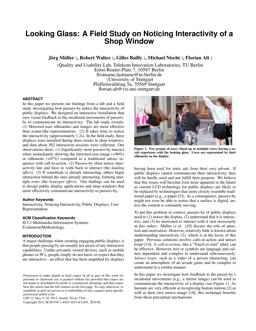
In this paper we present our findings from a lab and a field study investigating how passers-by notice the interactivity of public displays. We designed an interactive installation that uses visual feedback to the incidental movements of passersby to communicate its interactivity. The lab study reveals: (1) Mirrored user silhouettes and images are more effective than avatar-like representations. (2) It takes time to notice the interactivity (approximately 1.2s). In the field study, three displays were installed during three weeks in shop windows, and data about 502 interaction sessions were collected. Our observations show: (1) Significantly more passers-by interact when immediately showing the mirrored user image (+90%) or silhouette (+47%) compared to a traditional attract sequence with call-to-action. (2) Passers-by often notice interactivity late and have to walk back to interact (the landing effect). (3) If somebody is already interacting, others begin interaction behind the ones already interacting, forming multiple rows (the honeypot effect). Our findings can be used to design public display applications and shop windows that
more effectively communicate interactivity to passers-by.
more effectively communicate interactivity to passers-by.