Innovative procurement and cooperation increase joint development potential
4 December 2025
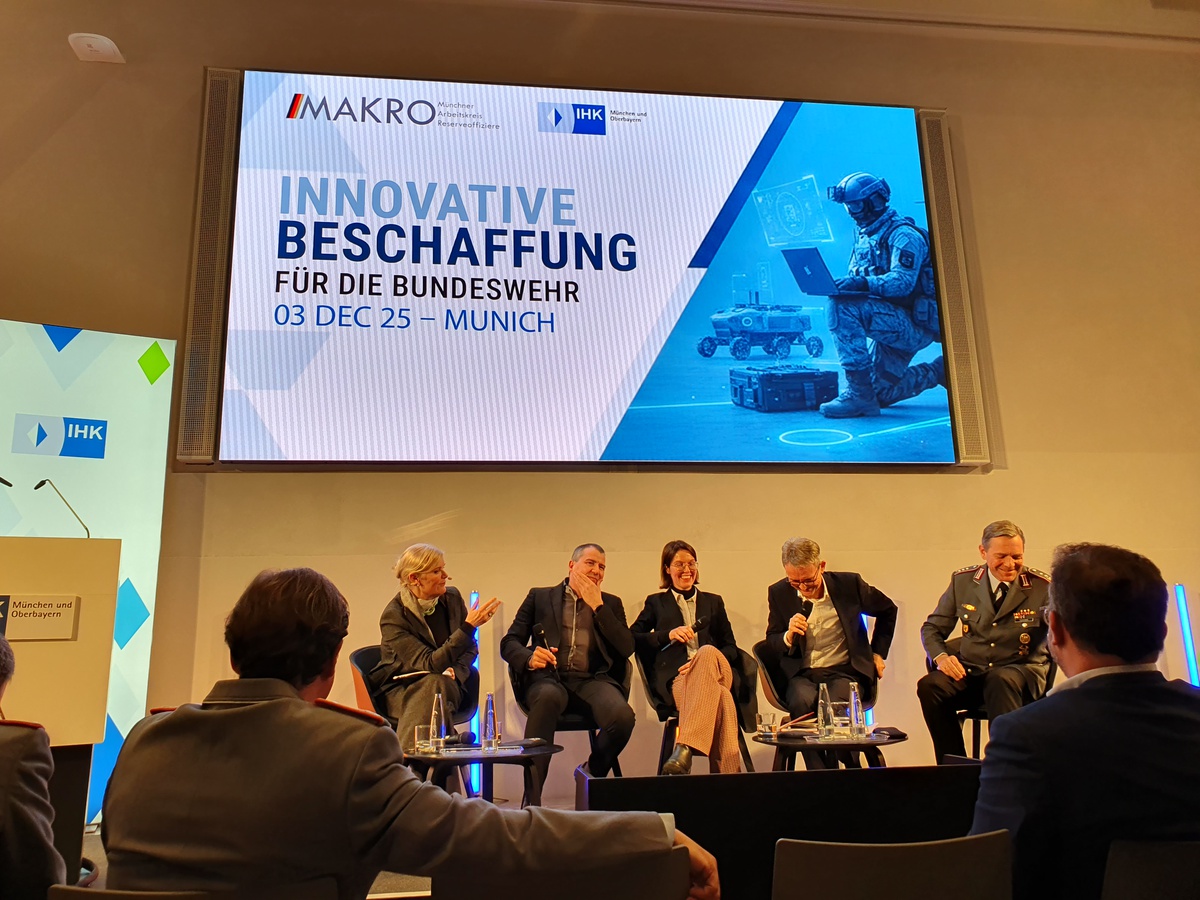
On December 3, 2025, the Munich Working Group of Reserve Officers (MAKRO e.V.) organized an exciting panel discussion at the Chamber of Industry and Commerce in Munich and Upper Bavaria on the topic of “Innovative procurement for the German Armed Forces - navigating the balance between law, technology, and operational reality.” Representatives of the German Armed Forces highlighted the challenges and adjustments that need to be addressed and how rapid contact between the German Armed Forces, industry, and research units can increase the speed of development.
The turning point in security policy presents the German Armed Forces with a historic challenge: capabilities must be delivered to the troops more quickly, more flexibly, and with more up-to-date technology. Against this backdrop, the topic of “Innovative procurement for the Bundeswehr - navigating the balance between law, technology, and operational reality” is becoming increasingly important and provides ample material for a high-profile panel discussion led by Prof. Dr. Rafaela Kraus (UniBw M) with representatives from the Federal Ministry of Defense, the Bundeswehr Planning Office, BAAINBw, and the University of the Bundeswehr: Brigadier General Michael Bender (BAAINBw), Lena Burth (Bundeswehr Planning Office), Prof. Dr. Michael Eßig (UniBw M), and Colonel Matthias Puschnig (BMVg / Special Task Force Ukraine).
While security-related technologies - from AI and robotics to networked sensors - are evolving in ever shorter cycles, the traditional procurement system remains complex and time-consuming. This brings the central question into focus: How can legally compliant procurement be combined with the necessary speed and innovative strength? New approaches such as rapid procurement, flexible testing grounds, and the increased use of commercial technologies show that a cultural change has begun. For SMEs, start-ups, and medium-sized industrial companies, this opens up new access to a market that has long been difficult to reach.
At the same time, the reality of deployment demands robust and practical solutions that are available not in ten years' time, but in the short term. The close interlinking of military requirements, technological possibilities, and legal frameworks is thus becoming a decisive factor for success. Research institutions and universities are providing important impetus in this regard by highlighting new methods, trends, and innovation paths and developing them together with industry (large companies, start-ups, and SMEs). Interest in this groundbreaking exchange was correspondingly high among industry, research, and the armed forces. Of particular interest were the opportunities presented for gaining a foothold in the German Armed Forces and the requirements and procurement system.
The discussion about innovative procurement is therefore not just an administrative or technical issue: it determines how quickly the German Armed Forces will be able to respond to threats in the future and how sovereign Germany will remain in terms of technology. The participants delivered clear messages, which were discussed further during the subsequent networking session:
- Colonel Matthias Puschnig (Federal Ministry of Defense/Special Task Force Ukraine) emphasized the role of Ukraine's experiences as an “accelerator”: In the field, it immediately becomes clear who is flexible and innovative in their delivery. Speed in the development and procurement cycle is crucial today - an appeal to industry, research, and start-ups to “get started and take off” now.
- Lena Burth (Bundeswehr Planning Office) encouraged industry, especially smaller companies, to actively approach the Planning Office: ideas and pitches are expressly welcome. If the benefits for the troops are apparent, the doors to the Federal Office of Defense Equipment and Information Technology (BAAINBw) will also open downstream. Challenges are also a way of steering innovation in the right direction and quickly developing experiences.
- Brigadier General Michael Bender (BAAINBw) highlighted the Innovation Center as a future central point of contact: a place where ideas, components, and technologies can be presented in an uncomplicated manner. A “marketplace” that brings together industry, research, universities, and the armed forces, makes trends visible, and builds expertise. It is particularly important that the troops can try out new solutions at an early stage – because practical testing leads to real innovations and ultimately to certifiable products.
- Dr. Michael Eßig (UniBw M) emphasized that public procurement law does not hinder innovation in any way: economic efficiency - not just the lowest price - must be the decisive factor. Competitions can be carried out in 35 days if they are designed correctly. He called for a rethink toward procurement that is market-oriented, facilitates access, and actively considers new suppliers. The security industry is a cross-sector industry with a future that increasingly lies in software and system integration - areas for which today's procurement processes are not yet designed.
Conclusion of the panel discussion: More courage, less hesitation. Innovation must be tried out, further developed, and then regulated - not the other way around. Shortcuts and networks such as NKCS, Cyber Alliance, or the Cyber Innovation Hub of the German Armed Forces will be crucial in the future, flanked by national and international support programs (BMBF, dtec.bw, NATO, EU). Creativity, speed, and networked working are therefore the keys to a modern, innovative Bundeswehr.
During the subsequent networking session, a number of innovative ideas were exchanged, troop requirements were identified, and contact was established with FI CODE, which was represented by PD Dr. Corinna Schmitt, who represented both the dual research of UniBw M and the NCC-DE with a focus on networking, funding advice, access to EU funding, and community building in cybersecurity.
Futher Links:
Munich Working Group of Reserve Officers (MAKRO e.V.): https://reserveoffiziere.de/
National Cybersecurity Coordination Centre Germany (NCC-DE): https://www.nkcs.bund.de/
Cyber Innovation Hub: https://www.cyberinnovationhub.de/
Notes regarding the photo, from left to right: Prof. Dr. Michaela Kraus (UniBw M), Brigadegeneral Michael Bender (BAAINBw), Lena Burth (Bundeswehr Planning Office), Prof. Dr. Michael Eßig (UniBw M), and Oberst i.G. Matthias Puschnig (Federal Ministry of Defense/Special Task Force Ukraine)
Photo: © SeCoSys/Schmitt