ERC CoG FDM^2

Structural multiscale modelling of extrusion-based 3D and 4D printed materials

A closer look at FDM technology


Fused deposition modelling (FDM) is a widespread 3D printing technology based on the extrusion of thermoplastic filaments initially used only for prototyping but recently also for the manufacturing of mechanical components. As regards 4D printing, it is an innovative technology used for smart material and structure production through 3D printing of shape memory materials. This project aims to fill a gap in our understanding of FDM materials' behaviour. The EU-funded FDM^2 project suggests that existing models are not able to conceive the complex behaviour of FDM materials; for that reason, the project intends to deliver a net understanding of the mechanics of FDM materials associated with instruments for the planning, analysis and perfection of FDM structural components.

Forschungsschwerpunkte

Mechanical Performance

Experimental Investigation

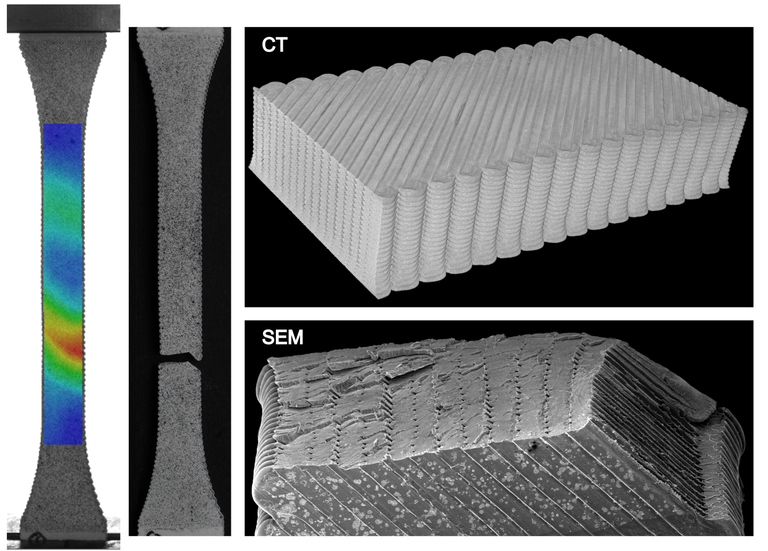
Computed tomography (CT) -scanning reveals the actual mesostructure of FDM printed parts. Its characteristics govern the mechanical performance of FDM printed structures.
 
Mechanical testing to characterize the performance of 3D printed parts. Investigating the influence of multiple printing parameters like temperatures, print speed, extrusion factor.
 
Scanning electron microscopy (SEM) to understand the mechanisms that lead to final failure of a part.

Numerical Modeling

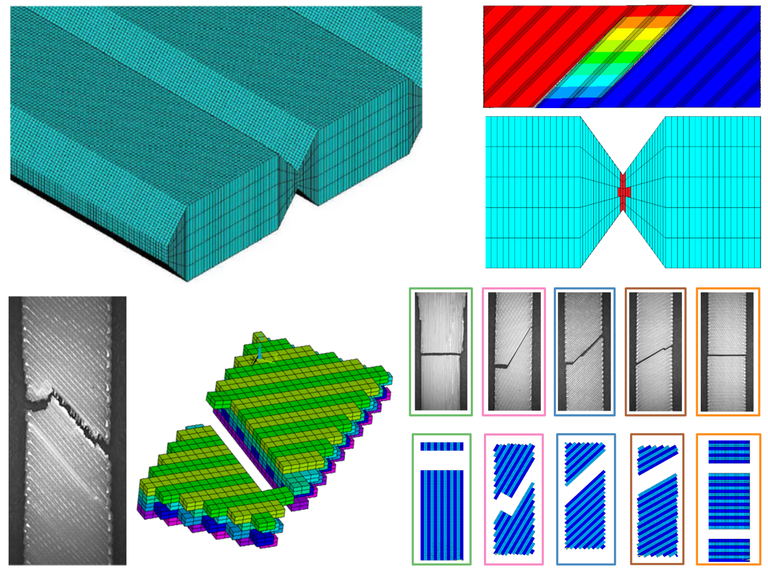
The common modelling approach is to consider the printed structure as a composite laminate. Such models cannot capture the complex behaviour of FDM materials beyond the linear elastic regime. It can only be understood by considering nonlinear effects at the mesostructure, which needs to be interpreted as a 3D structure of bonded fibres rather than an anisotropic solid. 


Based on these observations, new theoretical and computational frameworks are developed. All approaches represent the mesostructure as an arrangement of beams and consider debonding and fracture of these beams.


Understanding Thermal Effects

Modeling Thermal Distribution and History

Developing reliable numerical simulation of heat transfer during fused deposition modeling (FDM) to enable more accurate predictions of process-induced residual stresses, bonding quality, and the mechanical performance of printed components.

A key objective is to increase computational efficiency without compromising the physical accuracy of the deposition process, for example through adaptive mesh coarsening and advanced element activation strategies.

The thermal interaction between the printed part and its environment is investigated by calibrating thermal boundary conditions based on experimental measurements.

It is further examined how infill geometry, density, and air-filled structures influence heat transfer and identify simplified yet reliable modeling approaches for these complex internal features. Together, these developments provide a more efficient and experimentally validated simulation framework for predicting the thermal behavior of FFF processes, supporting the design of more reliable and higher-quality additively manufactured parts.


Viscous Material FLow

Investigating the origin and evolution of stresses during the material extrusion process in fused filament fabrication (FFF), which are a major cause of defects such as warpage, shrinkage, and delamination.

Using advanced finite element simulations combined with experimental validation, it is analyzed how stresses develop within an extruded filament as it cools and solidifies. Different material models are compared to accurately capture the thermo-mechanical behavior of the polymer during deposition.

The influence of key process parameters, including printing speed as well as nozzle and build plate temperatures, is systematically evaluated. The results provide a deeper understanding of stress formation during extrusion and support the optimization of process parameters to improve the dimensional accuracy and quality of additively manufactured components.

Real-World Applications of FDM

Printed Boat

Large-scale fused deposition modeling (FDM) involves substantially higher material flow rates than conventional additive manufacturing, making thermal effects a critical factor in process stability and print quality. These thermal phenomena impose significant constraints on the design of deposition strategies and the achievable component geometry. To address these challenges, a novel parametric workflow has been developed that enables continuous toolpaths and support-free deposition at overhang angles of up to 45°. The workflow is adaptable to a wide range of large-format additive manufacturing (LFAM) systems, providing a flexible framework for different machine configurations. Its capabilities are demonstrated through the fabrication of a fully functional boat hull featuring a watertight shell and a load-bearing structural design, highlighting the potential of advanced process planning for large-scale additive manufacturing.

Architectural Railings

The geometric freedom offered by fused deposition modeling (FDM) opens up new possibilities for architectural applications, where functional performance and aesthetic quality must be considered simultaneously. Railings represent a particularly demanding example, combining structural requirements with architectural design. A novel computational workflow has been developed that integrates both aspects within a single design process, enabling the creation of visually appealing and structurally efficient railing systems. The generated printing toolpaths are optimized based on numerical structural analyses, ensuring that material is placed where it contributes most effectively to the load-bearing performance. This integrated approach demonstrates how computational design and additive manufacturing can be combined to realize customized architectural components with enhanced functionality and design freedom.

Printed Concrete Formwork

Another promising application of fused deposition modeling (FDM) is the production of formwork for concrete construction, enabling the realization of novel and material-efficient structural designs. In particular, ribbed and waffle slab systems can significantly reduce the amount of concrete required compared to conventional solid slabs, thereby lowering the associated CO₂ emissions. To support this approach, reusable formwork elements are manufactured using FDM, providing a flexible and cost-effective alternative to conventional formwork systems. Initial studies demonstrate that these printed formwork elements can be reused multiple times and are fully recyclable at the end of their service life. This research highlights the potential of additive manufacturing to improve both the sustainability and design freedom of future concrete construction.

4D Printing

Programming Shape Shifting Mechanisms

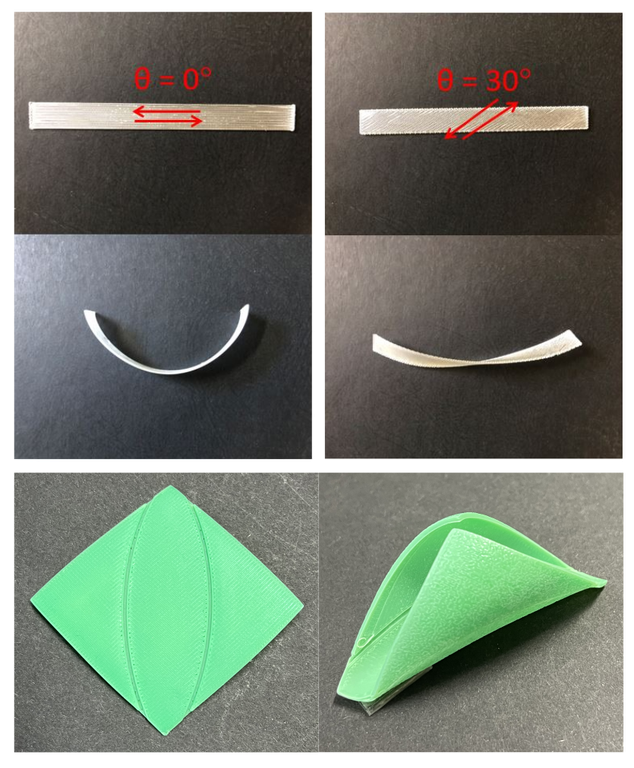
While residual stresses generated by high processing temperatures and rapid cooling are often regarded as a source of defects in fused deposition modeling (FDM), they can also be exploited to enable controlled shape transformations. By selectively reheating printed components, these stored stresses can be activated to produce predefined deformations, creating new opportunities for functional and adaptive structures. This research aims to establish a fundamental understanding of the underlying mechanisms governing stress generation and release, both qualitatively and quantitatively. The resulting insights provide the basis for predicting and controlling thermally induced shape changes, enabling the purposeful use of residual stresses as a design feature rather than a manufacturing limitation.