Explosion protection through planting
Explosion protection through planting - experimental and numerical investigations
In the area of structural protection, the wide range of terrorist threats is countered by a no less diverse range of structures and concepts for protecting people and infrastructure. The focus is traditionally on special structural solutions that are specifically designed for these types of loads. In the case of explosion loads in particular, however, there is the question of the extent to which structures that were not originally designed for this purpose can make a substantial contribution to the overall protection concept. The research group led by Professor Norbert Gebbeken focuses in particular on elements for the design of inner-city spaces. In this context, it is also of interest to what extent plants can be used specifically as explosion-inhibiting elements.
First experimental studies on the anti-explosion effect of thuja and cherry laurel delivered promising results and valuable information regarding the suitability of plants for this purpose. Expectations were in some cases clearly exceeded, particularly with regard to reducing the pressure effect. However, experimental investigations are extremely complex and expensive. Therefore, numerical simulations are used to limit the experimental effort. Numerical simulations of explosion propagation are fundamentally very calculation-intensive and become more complex with increasing complexity of the structures to be examined. Since every plant is unique with an extremely complex structure, a numerical model that is as abstract and largely simplified as possible is sought, which on the one hand captures the explosion-inhibiting effect of the plants with sufficient accuracy and on the other hand keeps the modeling and calculation effort within reasonable limits. For this purpose, it must be phenomenologically investigated which flow effects occur within the plants in the event of an explosion and what influence they have on the propagation of the explosion-induced air shock wave.
For this purpose, individual components of different real plants are three-dimensionally scanned by laser in order to then generate numerical models with a high level of detail (see figure). These are subjected to different explosion loads in simulations in order to analyze the flow conditions on the flexible branches and leaves. The knowledge gained from this is used to investigate to what extent the level of detail in the numerical modeling of plants under explosion loads can be reduced. Ultimately, an efficient approach for considering the explosion-inhibiting effect of plants in numerical simulations of explosion propagation should be developed.
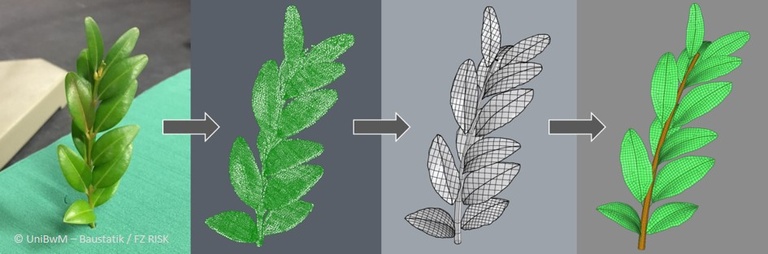
Figure 1: Step-by-step generation of a finite element model of a boxwood branch from a 3D laser scan.