Bridge Assessement Code - New Generation
Bundeswehr-specific software development
Bridge classification and bridge resilience with BRASSCO-NG
The rapid assessment of the load-bearing capacity of bridges is essential to ensure the mobility of one's own forces. The constant further development of the computing power of mobile devices today enables the application of technologies in a variety of areas. These possibilities offer new perspectives for the Bundeswehr, which can benefit above all from the quick handling.
Due to the rapid triumph of smartphones and tablets in today's society, we are only at the beginning of opening up new areas of application for computer programs. The ubiquitous acceptance and use of these mobile devices also represents new opportunities for the Bundeswehr. Commercial programs are only moderately suitable here, as they either cover too much or too little with regard to Bundeswehr-specific issues. In addition, the use of third-party software can result in weak points in data security and defense against external access. For this reason, software development that is designed for the special criteria of use in military operations is necessary.
Particular requirements, which the Bundeswehr asks for in software design, include the highest possible robustness of the program against misuse, strong structuring and clarity of the input, visual verification options and a clear interpretation of the results. In addition, an optimization with regard to the quantity and accuracy of the input parameters and the computing time must be made for use in the field. The current development of a program for bridge classification can be cited as an example of the necessary functionality.
There is a wide range on the commercial market for the calculation of structures and the creation of numerical models. The performance offered by these products often ranges from a simple two-dimensional calculation to a numerical calculation of complex three-dimensional models. The structures considered vary from simple warehouses to complex engineering structures. Where this variety of applications is in demand and required on the commercial market, a very small part of the covered spectrum is sufficient for the problems faced by the Bundeswehr. The large number of calculation and display options requires a high level of computing power, which is currently only achieved by computers and laptops. For this reason, the development of platform-independent software enables use on mobile devices on the one hand and a reduction of the input and application options to the essentials on the other.
In the case of the rapid classification of bridges described here, the modeling can be accelerated in that, like a construction kit, only certain partial cross-sections are available from which the overall cross-section of a bridge is compiled. With this approach, the model generation can be automated to a large extent, and only the variable cross-section dimensions and span lengths are required as input values. Once these values have been entered into the program, a visualization of the transverse and longitudinal systems is shown to enable the user to check the input. The calculation is then carried out and a permissible load (MLC = military load class) is output.
This is just one example of how the use of special software for the troops can bring benefits in the field. Through the constant dialogue with the end user, an efficient software can be created that covers the bridge types and geometries most frequently encountered in military use. As part of the further development of the Bundeswehr, new scenarios can also be integrated into the software.
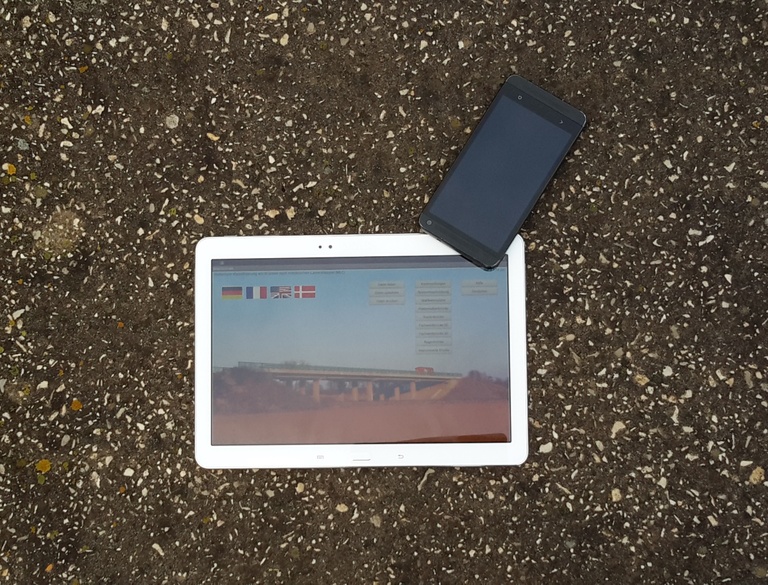
Figure: Mobile devices for using software in any situation