Dual-use is the future – military and civil security research hand in hand
3 November 2025
This year's conference of the National Cybersecurity Coordination Centre Germany (NCC-DE) focused on Europe. Against the backdrop of the current geopolitical situation, the topics of security and digital sovereignty are becoming increasingly important and require prompt action. With its conference in Cologne at the end of October, the NCC-DE provided a platform to support synergies, cooperation, and transfer, and to strengthen Europe through targeted investments and innovations. In addition to numerous presentations, there was also a session on “(EU) funding for research and development,” in which the Research Institute CODE organized one of three breakout sessions.
Digitalization and increasing technological interconnection are confronting our society, economy, and defense with new challenges. At the same time, they are offering immense opportunities. In the field of cyber defense, the boundaries between civilian and military use are becoming increasingly blurred: innovations resulting from civilian research can make a decisive contribution to security and defense capabilities, and vice versa. This intersection was the focus of the breakout session “Funding and Dual Use in the Cyber Defense Sector” organized by PD Dr. Corinna Schmitt from RI CODE: Funding, development, and strategic use of dual-use technologies in the cyber and security context. The aim was to examine how research funding, innovation ecosystems, and international networks can contribute to integrating key digital technologies responsibly and effectively in both the civilian and military worlds. The invited speakers presented different, complementary perspectives.

Dr. Annika-Kathrin Belz from dtec.bw explained how dual-use research can be strengthened through specific funding. (Photo: RI CODE / C. Schmitt)
Dr. Annika-Kathrin Belz from the University of the Bundeswehr Munich presented the Bundeswehr Center for Digitalization and Technology Research (dtec.bw) and explained how specific funding can enable and strengthen dual-use research at universities.
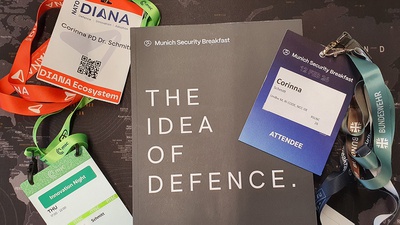
Isabel Grube from Palladion Defence Accelerator showed how programs such as NATO DIANA can turn disruptive ideas into viable dual-use business strategies and how synergies between start-ups, research, and defense could be utilized.
Finally, Stephanie Wißmann, researcher at the NATO Science and Technology Organization (NATO STO) and co-founder of a start-up in the field of cybersecurity, explained why networking between actors, disciplines, and institutions is a decisive success factor in cybersecurity. She also provided practical ideas on how this networking can be successful.

Isabel Grube from Palladion Defence Accelerator (l.) and Stephanie Wießmann from NATO STO (Photos: RI CODE / C. Schmitt)
The presentations emphasized that funding, innovation, and cooperation are the foundation for a resilient, technologically sovereign future in the cyber defense sector. Besides the traditional EU funding lines, there are various opportunities to collaborate with the Bundeswehr at national level or with NATO at international level. Technology that is developed and accepted quickly and easily in the civil sector can also have potential for military applications in the dimensions of cyber, space, air, land, and water, which can contribute to maintaining the security and sovereignty of society.
Photos: RI CODE / C. Schmitt