CODE Study Award 2025
19 Januar 2026
The Research Institute Cyber Defence and Smart Data (RI CODE), in collaboration with Giesecke+Devrient GmbH, has awarded the CODE Study Award 2025 to Justin Svrakic for his master's thesis. In his thesis, “Design and Optimization of a Multi-Agent System for Traceable Large Language Model-Driven Decision-Making in Cyber-Physical Systems: TADS,” the graduate of the master's program in computer science addresses an important issue in current AI-based systems, namely the traceable and rule-compliant decision-making of large language models in mission-critical cyber-physical systems.
Large language models show great potential for context-based decision support in many fields of application. At the same time, their probabilistic functioning, lack of transparency, and potential inconsistencies make them difficult to use safely in mission-critical environments. However, it is precisely in these environments that it is essential for decisions to be not only correct, but also verifiable, explainable, and clearly linked to rules and empirical knowledge.
The master's thesis was written in collaboration with Fraunhofer Singapore and involved a stay abroad of several months. In this international research context, the work focused on realistic issues in the field of autonomous systems and mission-critical applications. Close collaboration with the local research team made it possible to examine architectural issues not only theoretically, but also with a view to practical application scenarios.
The core of the thesis is the design of the Traceable Agentic Decision-Making System (TADS). TADS describes a multi-agent architecture that systematically combines case-based reasoning and retrieval-augmented generation and extends these with structured reasoning and verification mechanisms to make the decisions of large language models traceable. In addition to a case- and document-based knowledge base, TADS specifically uses the principle of chain-of-thought to translate decision-making processes into explicit, step-by-step argumentation paths. In addition, a chain-of-verification is used to systematically check and question these argumentation paths and compare them with formal guidelines and mission specifications. Decisions are thus based not only on previous cases and documented rules, but also on transparently structured and verified reasoning steps.
A central architectural principle is the strict separation of decision generation, validation, and execution. While an agent first generates a proposed solution based on similar cases, a separate evaluation agent checks this proposal against documented rules and operational specifications. If rules are violated, the proposal is iteratively revised until a compliant decision is reached. This means that unvalidated proposals cannot be executed directly at any time.
In addition to the conceptual design, TADS was implemented as a prototype in a simulated environment. In a reconnaissance and surveillance scenario, the extent to which previous decisions influence system behavior and the degree to which the integrated validation loop ensures compliance with guidelines were investigated.
The experimental evaluation shows that historical cases have a measurable influence on decision-making, but at the same time, the architecturally anchored validation does not allow any rule violations. The work thus demonstrates that adaptive decision-making and formal traceability are compatible with each other through appropriate system architecture.
With his master's thesis, Justin Svrakic makes an important research contribution to trustworthy artificial intelligence in the field of cyber defense. The thesis combines theoretical foundations, a clearly structured architectural approach, and a well-founded prototypical implementation, thereby addressing a highly topical and challenging research problem.
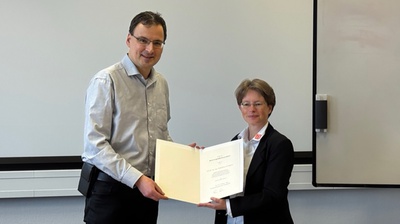
The CODE Study Award was presented during the master's graduation ceremony on December 13, 2025, on the campus of the University of the Bundeswehr Munich (UniBw M) by Vice President Prof. Geralt Siebert in the presence of CODE's Executive Director Prof. Wolfgang Hommel, Prof. Stefan Pickl, Head of the COMTESSA research group, and Dr. Michael Tagscherer, Group Vice President and CTO of Giesecke+Devrient GmbH.
Teaser image: Award winner First Lieutenant Justin Svrakic (center) with Prof. Dr. Geralt Siebert, Vice President of UniBw M, Dr. Michael Tagscherer, Group Vice President and CTO of Giesecke+Devrient GmbH, Prof. Dr. Stefan Pickl, Head of the COMTESSA Research Group, and Prof. Dr. Wolfgang Hommel, Executive Director of RI CODE (from left to right). (Photo: UniBw M / Siebold)