March 2026
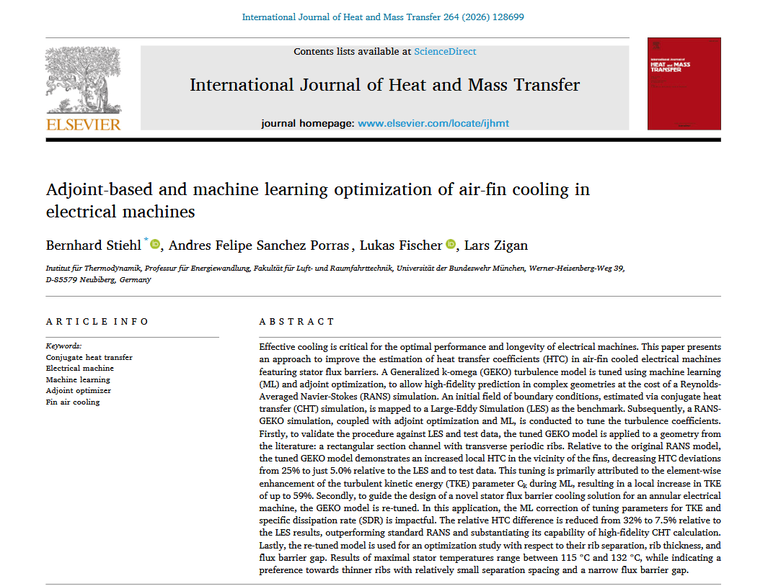
In our new research article “Adjoint-based and machine learning optimization of air-fin cooling in an electrical machine”, published in the International Journal of Heat and Mass Transfer, we extended the knowledge on cost-efficient Computational Fluid Dynamics (CFD) simulation strategies. 💸 💻💡
The article can be found here https://www.sciencedirect.com/science/article/pii/S0017931026003753
Specifically, adjoint optimization and machine learning was used to tune a Generalized k-ω (GEKO) turbulence model for conjugate heat transfer simulation. Due to the local enhancement of turbulent kinetic energy in a ribbed channel domain, heat transfer error was reduced substantially. The tuned model is validated against LES and test data, providing high-fidelity results at the cost of a RANS simulation. The validated model is used for a design study, to optimize stator flux barriers in an electrical machine. Maximal stator temperature is reduced with thin ribs at small separation spacing and a narrow flux barrier gap. Our work summarizes the capabilities and avenues of simulation as a powerful tool to guide the design of new technology.
This research, part of the ELAPSED project (Electric Aircraft Propulsion – safe, efficient, digitally linked), is funded by dtec.bw – Digitalization and Technology Research Center of the Bundeswehr, at the Bundeswehr University Munich, with support from the European Union’s NextGenerationEU initiative.