On-Demand Shuttle

On-Demand Shuttle Simulation

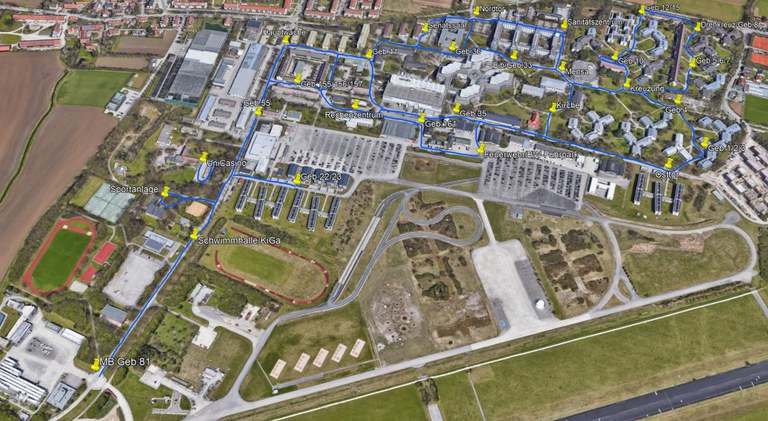
In the first phase of the MORE project, an on-demand shuttle system as a new mobility concept in the university campus was investigated using a microscopic traffic simulation. The overarching objective of this research was to design, implement, and evaluate an on-demand ride-pooling system within a Vissim microscopic simulation environment. This entailed the development of optimum assignment strategies, integration of passenger and operator preferences into the decision-making process, and analysis of system performance under varying operational scenarios.

Two vehicle-request matching algorithms, spontaneous and batch assignment, were implemented and applied in the Vissim microsimulation tool including an external control via the COM interface.

Extensive simulation experiments were performed for a typical weekday on the campus of the University of the Bundeswehr Munich, providing a realistic test environment. A broad set of KPIs including service rate, sharing rate, mean waiting time, mean detour time, total mileage, mean mileage, vehicle occupancy, mileage index, and empty mileage ratio, were systematically analyzed. Several simulation runs evaluated the impact of operational parameters on system performance, while others investigated the temporal evolution of KPIs throughout the entire simulation day. Additional scenarios assessed the effects of travel demand, cost function weighting, and batch periods. Furthermore, comparisons between ride-hailing and ride-pooling operations, as well as between different matching strategies, were conducted. The findings confirmed that the developed matching methodologies could be effectively applied within a microscopic simulation, and offer valuable insights into the operational performance of the on-demand ride-pooling system.

In the current phase of the MORE project, the transferability of the developed on-demand shuttle system to an urban region is being investigated. The university campus has its specific characteristics, such as moderate traffic volumes, the absence of traffic lights and a multimodal traffic environment. However, in an urban region, these aspects may differ significantly. Therefore, one goal of this project phase is to explore how the concept of an on-demand shuttle system can be adapted to urban conditions while accounting for these differences.

The municipality of Gemeinde Neubiberg has been selected as the case study area for the project. Within this scope, a digital twin of the municipality is created in the microsimulation model, including key public transport hubs. The current matching algorithms are also enhanced with new features, such as group booking of requests (i.e., more than 1 person per request) and constraints related to latest arrival at public transport hubs to ensure successful connections. Finally, important key performance indicators (KPIs) are evaluated to assess the system’s performance in a typical urban setting.

The second objective of the current phase of the MORE project is to explore how evacuation scenarios involving on-demand shuttles can be analyzed using traffic simulation. These scenarios are critical for modeling responses to emergency or unexpected events. In the context of the Bundeswehr, specific security-related incidents may require fast and well-organized evacuations. When a large number of people need to be evacuated simultaneously from various buildings or facilities (e.g., the University of the Bundeswehr Munich campus), it is essential to simulate these processes in advance to determine whether the planned measures are sufficient. Here, the optimum routing algorithms have to be applied.

The aim of this research is to simulate evacuation scenarios for planned/unplanned large-scale events on the campus of the University of the Bundeswehr Munich. By extending the current microsimulation model of the campus where necessary and further developing the on-demand algorithms, such scenarios can be simulated. These evacuation scenarios will then be defined and evaluated to validate the enhanced model.

Work packages

  • Urban scenarios in on-demand simulation
  • Evacuation scenarios of the university campus in on-demand simulation


Ansprechpartner

Oytun Arslan M.Sc.

Oytun Arslan M.Sc.

Wiss. Mitarbeiter
Gebäude 41/100, Zimmer 041/6123
+49 89 6004-2525