Signal Processing

Welcome to the Chair of Signal Processing
and the Munich Center for Space Communications


Prof. Dr.-Ing. Andreas Knopp, MBA
University of the Bundeswehr Munich
Chair of Signal Processing
Werner-Heisenberg-Weg 39
D-85579 Neubiberg

Munich Center for Space Communications

We innovate satellite networks, build scientific careers and link society to space.


News

All News
 
© Universität der Bundeswehr München/Simone

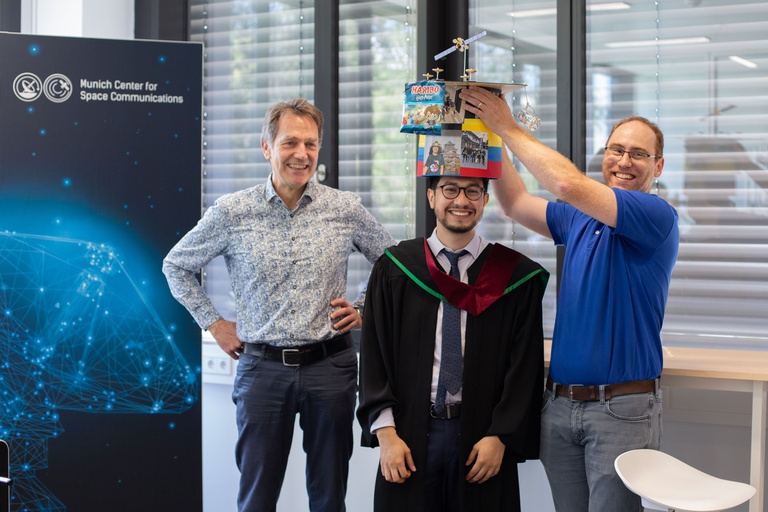
June2026 - PhD thesis defense by Oscar Martinez

Mr. Martinez successfully defended his doctoral thesis and was awarded the PhD degree with the distinction of magna cum laude.
His research was conducted within the framework of the European Doctoral Network HARMONY, funded by the European Union’s Horizon Europe research and innovation programme.
HARMONY is an Industrial Doctoral Network dedicated to the development of innovative satellite system architectures, with a particular focus on distributed solutions. Within this context, Mr. Martinez carried out pioneering research on “MIMO Feeder Links for LEO Constellations.” His work addresses one of the key challenges of future satellite communication systems: the capacity bottleneck of feeder links, which provide the high-throughput connection between terrestrial gateway stations and satellites. By exploiting multiple-input multiple-output (MIMO) techniques with several antennas onboard satellites and geographically distributed ground antennas deployed over areas only a few kilometers in diameter, the proposed MIMO LEO feeder-link architecture significantly increases the achievable data rates between the terrestrial core network and the space segment compared to current approaches.
In addition, Mr. Martinez developed an innovative active antenna concept for gateway stations that combines mechanical and electronic beam steering. This hybrid approach enables efficient tracking of rapidly moving LEO satellites while maintaining a cost-effective level of system complexity.
The doctoral examination committee consisted of Prof. Claus Hillermeier (Chair of the Examination Committee, Universität der Bundeswehr München), Prof. George Goussetis (Heriot-Watt University), and Prof. Andreas Knopp (Supervisor, Universität der Bundeswehr München).
We warmly congratulate Dr. Martinez on this outstanding achievement and wish him all the best in his future career.
 
© Universität der Bundeswehr München/Simone

Prof. Dr. Andreas Knopp Receives Hermann Oberth Medal

May 30, 2026. Prof. Dr. Andreas Knopp has been awarded the Hermann Oberth Medal by the International Spaceflight Association (IFR).
The Hermann Oberth Medal honors outstanding scientific and experimental contributions to space engineering. Founded in 1969, the IFR has promoted space activities and fostered exchange between science, industry, and society for decades, continuing the legacy of space pioneers Hermann Oberth and Wernher von Braun.
The award recognizes contributions to a new, agile approach to space research, pursued among others through the SeRANIS project. This approach combines rapid technology development and early in-orbit demonstration with a strong focus on technology transfer and practical implementation.
A particular emphasis lies on transferring emerging space technologies into industrial applications and building an innovation-driven ecosystem, including an active startup and technology-transfer culture.
The work focuses especially on dual-use technologies in satellite communications and space-based sensing and reconnaissance, particularly at the interface between mobile and satellite communications.
The award highlights a research approach that closely connects scientific excellence, industrial implementation, and technological sovereignty.
 
© Universität der Bundeswehr München/Simone

PhD thesis defense by Stephan Winter

April 14, 2026: Mr. Stephan Winter completed his doctoral studies, earning his PhD with the prestigious distinction of summa cum laude. His dissertation, titled "Channel Model for Terrestrial Fixed Service Interference to Aeronautical Satellite Receivers" represents an important contribution to the field of of satellite communications and spectrum management, particularly in understanding and mitigating interference between terrestrial and aeronautical systems.
Dr. Winter’s research examined how terrestrial point-to-point links interfere with in-flight satellite communications terminals in a spectrum governed by regulatory constraints. It developed a novel, scalable stochastic interference channel model that captures both statistical distributions and temporal dynamics. The outcome is a regulation-compliant model that enhances the resilience of in-flight connectivity systems and provides a solid basis for mitigating interference.
The jury was composed of Prof. Stefan Lindenmeier (Chair of the Examination Committee, UniBw M) and the examiners Prof. Vijitha Weerackody (Johns Hopkins University), Prof. Andreas Knopp (UniBw M) and apl. Prof. Christian Hofmann (Supervisor, UniBw M).
We wish Dr. Winter all the best for his future career!
 
All News