Node Architectures for Next-Generation Optical Networks
Every video call, cloud service, AI workload, and mobile connection ultimately depends on optical fiber networks. These networks form the Internet's high-capacity transport layer. As traffic continues to grow, simply adding more wavelengths per fiber is no longer enough in the long term. A natural next step is to use more spatial resources, for example, by deploying several fibers in parallel. This concept is known as space-division multiplexing (SDM).
Multi-fiber SDM is especially relevant because it is already practical: operators often install cables with many fibers, even if not all of them are initially used. However, adding more fibers creates a new architectural problem. Network nodes, where optical signals are routed from one link to another, must also scale. These nodes rely on wavelength-selective switches (WSSs), which route optical signals to different output ports depending on where they need to go. Current node architectures can be extended by adding more WSSs and increasing their port counts, but this approach may become expensive, power-hungry, or technically infeasible as the number of fibers grows.
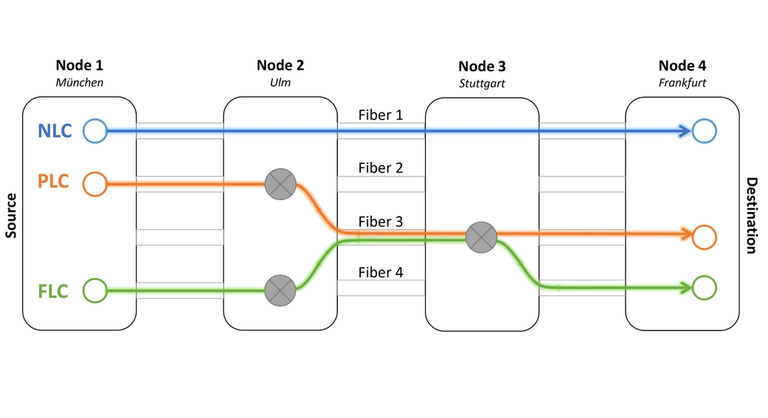
This thesis studies three possible ways to design such nodes. In No Lane Switching (NLC), each fiber behaves like an independent network layer. This is simple and scalable, but capacity can become fragmented because unused spectrum in one fiber cannot easily be used by another fiber. In Full Lane Switching (FLC), any optical signal can be moved from any fiber to any other fiber at any node. This provides maximum routing flexibility and can improve spectrum usage, but it requires very large WSS port counts, which may exceed current technology capabilities. Between these alternatives, Partial Lane Switching (PLC) allows lane changes only at selected nodes or under specific conditions, for example where spare WSS ports are available without requiring additional hardware.
The goal of this thesis is to understand when each architecture makes sense. The student will perform a power and techno-economic analysis of NLC, PLC, and FLC across different network topologies and traffic-growth scenarios. The central question is: how much flexibility is really worth paying for? The work will investigate when FLC becomes technically infeasible, when PLC provides most of the benefit at lower cost, and how the different architectures compare in terms of capacity, cost, and power consumption. The implementation will build on an existing C++ network simulation library.
Target group:
Uni: BA oder MA für KT, ST, ME
Requirements:
Basic coding experience, C++ is useful but not mandatory, techno-economic modeling for communication networks, basic Git version control, optical network planning and simulation.